

Hotels vs Airbnb: how to choose accommodation (without regretting it) when traveling from Colombia to Europe and LATAM
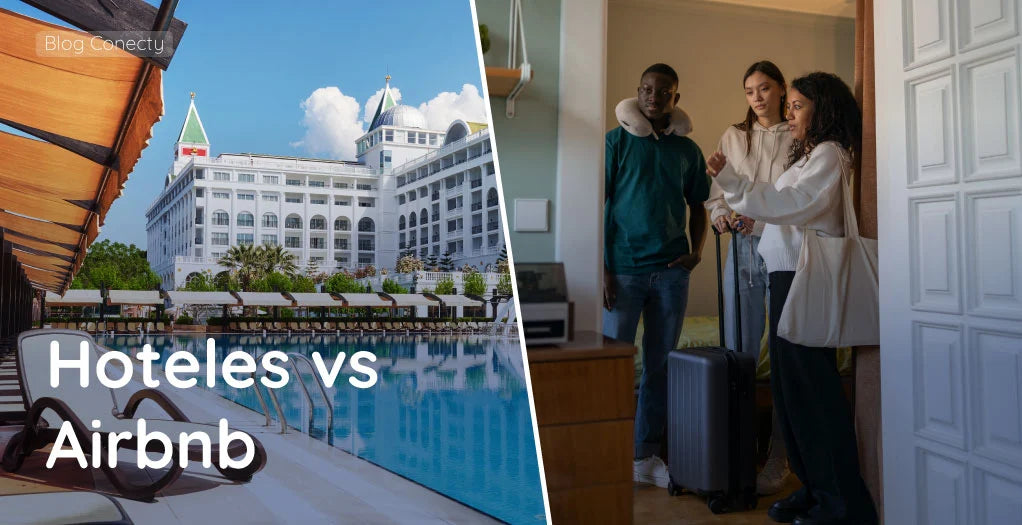
There's a decision that seems simple but defines the entire tone of the trip: where you're going to stay 🏨🏠. And it's not just “hotel or Airbnb”. It's: do I want everything taken care of when I arrive, or do I prefer a more flexible and local plan? Am I traveling as a couple, with family, alone, with friends? Am I going to walk all day or do I need a quiet base to recharge 🔋?
This guide is for you, Colombian tourist traveling to Europe or Latin America 🌍✈️, who wants to choose well without falling into typical traps: pretty pictures that don't match reality, locations "close to everything" that end up being far away, hidden rules, or reservations that become a stress 😮💨.
The real difference: tranquility vs autonomy
What a hotel offers you
A hotel is designed so that you don't have to think about logistics: you arrive, check in, you're given a key and that's it. In most cases, you have:
- 🛎️ Reception and support (if something goes wrong, someone responds)
- 🧹 Cleaning (usually daily)
- 🧳 Services that reduce friction: luggage storage, recommendations, taxis, etc.
- ✅ Fewer surprises: what you see is usually what you get
A hotel is ideal if your trip is short, if you have a tight itinerary, if you arrive late, if you're moving between cities, or if you want to relax without "managing" a house.
What an Airbnb offers you
Airbnb (and similar private accommodations) often give you something a hotel doesn't: space and real life. You can stay in a residential neighborhood, have a kitchen, living room, washing machine, and even feel like "living" in the destination.
- 🕒 Total autonomy: more flexible schedules, kitchen, more square meters
- 🏘️ Local experience: neighborhood bakery, market, cafes off the tourist circuit
- 👨👩👧👦 Ideal for long stays or group trips
But here's the uncomfortable truth: the experience depends heavily on the host and the place. That's why prior research weighs double.
Quick comparative table
⚡ What almost no one tells you: "cost" isn't always money (it's energy)
Sometimes the hotel isn't "more expensive," it's lighter: fewer things to sort out.
And sometimes the Airbnb isn't "cheaper," it's more demanding: more decisions, more fine print, more coordination 🧠📋.
Ask yourself this before booking:
❓ Do I want to spend energy on the destination... or spend it on figuring out accommodation?
🛡️ Safety: how to think about it in Europe vs. LATAM
In Europe
In general, the challenge is not usually "violence", but theft and highly touristy areas where pickpockets operate. In this context:
🏨 Hotel: controlled access, reception, safes, more containment if something happens
🏠 Airbnb: can be excellent, but requires thoroughly researching the building and the neighborhood
If you are traveling alone or it's your first time in that city, a well-located hotel can provide a more peaceful base.
Airbnb can be incredible in Europe, especially if you want to experience the neighborhood, but choose with solid reviews and a clear location.
In Latin America
Here, the neighborhood really matters (even if you're Colombian and feel like you "already know your way around"). In several tourist cities, hotel zones are designed for tourists: better lighting, more reliable transportation, more services.
🏨 Hotel: usually in strategic areas, with local support and less exposure
🏠 Airbnb: great if the neighborhood is right; risky if you "saved" by staying somewhere you don't know
🔑 Simple rule: if you don't know the city, prioritize location and safety over square footage.
🔄 Cancellations and changes: the factor that saves your trip
In tourism, plans change: flights, connections, health, weather 🌧️✈️. Here's a practical difference:
🏨 In hotels (especially via platforms), it's common to find clearer conditions and some flexibility, although most hotels offer you the possibility to change your dates without surcharges, as long as there are more rooms with the same qualities as the one you chose, available.
🏠 On Airbnb, the policy changes depending on the host: there are flexible options, but also strict conditions. Here it is vital that before booking, you read the booking rules carefully to avoid uncomfortable or costly surprises 💸.
💡 Realistic advice: if your trip has fragile dates (with layovers, trains, changes between cities), prioritize bookings that don't tie you down and that offer free changes and cancellations.
Who wins depending on your type of trip?

💑 Couple's trip (romantic getaway)
Hotel if you want relaxation, zero logistics, and a more "pamper me" plan.
Airbnb if you dream of "living the city": cooking delicious eggs for breakfast, having a terrace, and a beautiful view of the neighborhood.

👨👩👧👦 Family trip
Airbnb if you need space for the "20 suitcases", a kitchen for the troupe, a washing machine for the kids' clothes, and a more comfortable routine.
Hotel if you want your vacation to truly be a vacation: daily cleaning, a hot breakfast without effort, and support with entertaining the little ones.

🍻 Trip with friends
Airbnb usually wins for cohabitation: a living room for a relaxed beer chat, a kitchen for a quick dinner, and enjoying time all together.
Hotel if everyone wants independence, to avoid rules with neighbors, to leave their things wherever they please, and to order room service without consulting anyone else's wallet.

🧍♀️ Solo trip
Hotel if you prioritize feeling supported, moving easily, and feeling safer and accompanied.
Airbnb if you choose an entire accommodation with excellent reviews or are looking for a more local experience (and you like to manage things yourself).
🧭 Platforms: how to book "well" (and what to check no matter what)
Without committing to just one, the point is to book with platforms that give you:
⭐ Verifiable reviews
🛎️ Customer support
📄 Clear policies
📍 Location and condition information
Airbnb and Booking are usually the most mentioned among people, and among those that meet the list of essential requirements.
✅ Checklist before paying (applies to hotels and Airbnbs)
- 📍 Actual location: check the map, see what's around, and how far it is from what you're going to do.
- ⭐ Recent reviews: read the bad ones (that's where the truth is). And pay attention to the intermediate ones (4 or 3 stars), as bad reviews sometimes complain about things like cancellations or poor coordination, but intermediate ones tend to be more objective people.
- 📏 Rules and restrictions: noise, visitors, hours, deposit, checkout instructions.
- 📶 Connectivity and comfort: WiFi, elevator (Europe: key), heating/AC depending on the season.
- 🕒 Check-in: how do you get in, at what time, with whom, what happens if you arrive late?
🗺️ Tourist services: Who gets you closer to the plan?
🏨 Hotel: usually close to attractions, helps you with tours, sorts out transportation, and gives you an easy pace.
🏠 Airbnb: connects you with the local scene, gives you neighborhood life, markets, restaurants "without a queue", and less obvious routes.
✨ It's simple: if your trip is about "seeing everything", hotel 🏨.
If your trip is about "feeling the place", Airbnb 🏠.
And in either case, there's something that can save your trip: having internet 📶.
Because getting around with maps, reaching tourist spots, booking tickets or tours (sometimes with a discount), and arranging transportation in minutes literally depends on being connected 📍📱.
📶 Final (very real) tip: your trip feels different when you arrive connected

Whether it's a hotel or Airbnb, there's a recurring point: the arrival. When you land tired, with luggage, looking for an address, opening maps, translating messages from your host, or confirming your reservation… running out of data can complicate things unnecessarily 😵💫📍.
That's why, when traveling from Colombia to Europe or LATAM, it's most practical to leave with your SIM or eSIM ready: you land, turn on your data, and sort out the basics without relying on Wi-Fi ✈️📱.
With Conecty, for example, you can buy it before you travel and arrive with connectivity from the first minute (and if you're one of those who leaves it till the last minute, you can sort it out in very little time from the app).
🧭 Conclusion: it's not "hotel vs. Airbnb," it's "what kind of trip are you looking for?"
If you want zero friction, to have support, cleaning, and a strategic location: hotel 🏨.
If you want space, autonomy, and local life (and don't mind managing things yourself): Airbnb 🏠.
The best decision is the one that aligns with your energy, your plan, and your travel style.
And when that fits, accommodation stops being “an expense” and becomes part of the journey ✈️💛.


