

Barcelona travel guide: how to experience the city through its neighborhoods, flavor, and sea
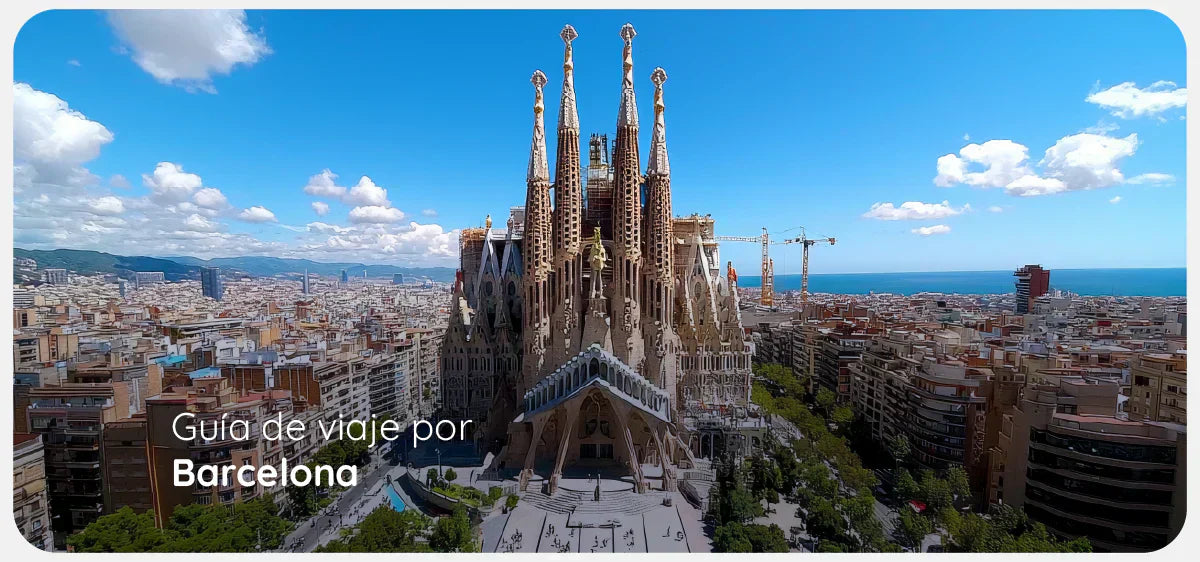
There are cities you visit to see places. And there are cities you visit to feel how people live there. Barcelona belongs to the second category. 🌊
Of course, it has picture-postcard spots everyone wants to tick off their list: the Sagrada Familia, the Gothic Quarter, Park Güell, Barceloneta. But what truly makes this city special isn't just its iconic sites, but how it reveals itself. Barcelona doesn't give itself away all at once. It unfolds in layers: in a narrow street in the historic center, on a neighborhood rambla where everything moves slower, on a terrace where you linger longer than you planned, in a dish that tastes of the sea, of olive oil, of tomato, of cooking done without haste.
The beauty of traveling to Barcelona is precisely that: you can go for the famous and end up falling in love with the everyday. ✨
What will you find in this blog? 🧭
- Before buying, decide where it's best for you to enter ✈️
- The best time to visit Barcelona ☀️
- Sleeping well is also part of traveling better 🛏️
- Some famous places really do live up to their reputation 🏛️
- The Barcelona you remember most isn't always the most obvious 🌿
- Eating in Barcelona is another way to understand it 🍽️
- How to get around Barcelona without getting confused 🚇
- Entry requirements for Colombians 🛂
- Recommendations for experiencing Barcelona with more intention 💙
✈️ Before buying, decide where it's best for you to enter
Flying directly to Barcelona isn't always the best route.
If you're traveling from Colombia, Madrid often ends up being an easier or more convenient entry point because it concentrates more direct routes from Bogotá: there are daily non-stop flights with Avianca, Iberia, and Air Europa to Madrid, while Barcelona usually has a more limited offer.
Therefore, when searching for flights, it's worth comparing two options: flying directly to Barcelona or entering through Madrid and continuing by train. This second alternative might be useful if you find a better airfare or better schedules. Renfe operates the Madrid–Barcelona route at high speed, with direct travel times of around 2 hours and 30 minutes, and a very high frequency between both cities.
In other words: before buying, don't just focus on the flight's final destination. Sometimes, entering through Madrid and completing the journey by train can give you more flexibility, better prices, or a more comfortable arrival, plus a moment to enjoy the Spanish landscape while sipping a coffee in the train cabin. ☕
☀️ The best time to visit Barcelona
The city changes a lot depending on the month you visit, and that's definitely worth considering before buying.
Barcelona has that rare advantage of being a city that works almost all year round. It's not a destination that depends on a single season, because it always has something to offer. Even so, there are times when it's best enjoyed.
For us, the best time to visit is between April and June, and then between September and October. In these months, the city feels welcoming: there's good light, the weather is pleasant, walking isn't as tiring, and you can move between neighborhoods, museums, terraces, and strolls without the burden of the harshest heat or the feeling of being in high season all the time.
In July and August, Barcelona has a lot of energy, yes, but also intense heat, more tourists, and a more frenetic pace. It can be a good time for those who want the beach, outdoor activities, and a more vibrant city, but not necessarily the most comfortable for exploring it calmly.
In contrast, spring and early autumn are very well suited for a trip that wants to feel balanced: enough street life, pleasant weather, and a city that can still be explored on foot without too much effort. 🍃
🛏️ Getting good rest is also part of traveling better
In Barcelona, choosing the right neighborhood to stay in can completely change your experience.
Many people think about the hotel first and then the area. In a city like this, it should be the other way around.
If it's your first time, Eixample is usually a very good base. It's practical, beautiful, orderly, and keeps you well connected to modernist Barcelona, the city center, and several of the best-known areas. Plus, it has that mix of beautiful architecture, urban life, and comfort that makes returning at the end of the day feel good too.
Now, if you're interested in a more local, breathable, and less "touristy" experience, Poblenou and Gràcia are two beautiful options. Poblenou has a very special energy because it mixes an industrial past, neighborhood life, the sea, and a more contemporary city. Gràcia, on the other hand, retains that village feel within the big city: squares, small streets, lively bars, and a much more intimate atmosphere.
It's not always about sleeping "in the center." Sometimes it's about sleeping in a place that makes you feel like you're inside Barcelona, not just near its attractions.
🏛️ Some famous places really do live up to their reputation
The key isn't to avoid them. The key is to experience them well.
And then there's Barceloneta, which beyond the beach has something very unique: a direct relationship with the sea, with the light, with the city's seafaring history. It's perfect for slowing down, walking, sitting for a while, and letting Barcelona become less monumental and more sensory. 🌊
🌿 The Barcelona you remember most isn't always the most obvious
There's a part of the city that's best enjoyed when you stop chasing "must-sees."

One of those places is la Rambla del Poblenou. And we really like to include it in this guide because it changes the conversation a bit. It's not the most obvious Barcelona, but it is one of the most lovable. It has terraces, local shops, people going about their daily lives, and a much calmer energy than other more saturated areas. It's a rambla for walking aimlessly, for sitting down to eat, for watching, for staying a little longer than planned.

We also want to include El Born on that list of unmissable places. It has history, yes, but also a very beautiful life of bars, restaurants, and streets with a lot of character. It works very well for the afternoon or evening, when Barcelona becomes softer, more conversational, more about drinks and after-dinner talks. 🍷
And if you like that city that opens up a bit and gives you breathing room, Montjuïc also deserves a place. Going up there changes your perspective: the city looks different, wider, more serene, and it also connects you with museums, gardens, and slower-paced activities.
🍽️ Eating in Barcelona is another way to understand it
Here it's not just about eating well. It's about sitting in places that truly connect with the city you're visiting.
Barcelona has a cuisine that feels very honest: lots of fresh produce, lots of seafood, lots of well-made simplicity. And that's noticeable in something as basic as good pan con tomate, as well as at a table where rice, fish, seafood, olive oil, and seasonal vegetables do almost all the work.
That's why, rather than generically looking for "tapas," it's worth aiming for places that have a piece of Barcelona inside them. If you want a more classic meal, with history and traditional Catalan cuisine, 7 Portes is a great reference in the city, well-known for its history and its rice dishes.
If what attracts you is that maritime Barcelona, then Barceloneta is a very good area for eating well. There you can find places like Can Ramonet, which mixes tradition and fresh produce right in the neighborhood, or Can Ros, a tavern with over a hundred years of history and a proposal closely linked to Catalan seafood cuisine, with fish, shellfish, and rice dishes.
And if you want a more special meal, with a view of the port and a very Mediterranean experience, you can also visit the Barceloneta restaurant, facing Port Vell, very associated with fish, seafood, and rice dishes.
The idea, in the end, is that eating in Barcelona doesn't feel like a pause between plans, but rather a part of the journey. Because sometimes a city also stays with you because of what you tasted at the table.
🚇 How to get around Barcelona without getting confused
Barcelona is delightful to walk, but understanding how its public transport works saves you time, fatigue, and more than one confusion upon arrival.
The simplest thing for a tourist is this: if you're going to use transport several times a day for 2 to 5 days, the Hola Barcelona Travel Card is convenient, as it gives you unlimited travel and also includes the metro journey between the airport and the city center. If you think you'll walk a lot and only use transport occasionally, the T-casual, which includes 10 journeys, is more suitable.
Tickets or cards can be bought at metro station machines. On the metro, you enter by validating your card or ticket at the turnstiles, and on the bus, you validate when boarding. If you don't have a pass, on many buses you can pay the single fare directly with a contactless bank card.
There's an important detail with the airport: the T-casual does not work for entering or leaving the Aeroport T1 and Aeroport T2 stations of the L9 Sud metro. For that journey, you need a ticket that includes the airport, such as the Hola Barcelona Travel Card, the T-usual, or you can buy the Airport ticket, which costs €5.90 (approx. $26,000 COP, or $8 USD).
The metro operates from 5:00 a.m. From Monday to Thursday it runs until midnight, Fridays until 2:00 a.m., Saturdays it runs all night, and Sundays it ends at midnight. If you arrive very late, there's also the NitBus, which covers the city at night.
In summary, for a traveler, the easy rule would be this: Hola Barcelona if you want to move around without much thought, T-casual if you'll walk a lot and only use transport for some journeys.
🛂 Entry requirements for Colombians
Before thinking about itineraries, there's something that needs to be resolved: what might be asked of you when entering Spain.
If you have a Colombian passport, you can enter Spain without a visa for tourism, as long as your stay is no longer than 90 days.
However: entering without a visa does not mean entering without requirements. The authorities may ask you for:
- Valid passport, issued within the last 10 years and with at least 3 months validity after the planned departure date from the Schengen area.
- Accommodation reservation or invitation letter, depending on where you will be staying.
- Ticket out of Spain or for continuation of the journey.
- Proof of purpose of travel, for example, tourism, family visit, or short unpaid trip.
- Sufficient funds for the stay. Currently, Spain requires proof of 118.40 euros per person per day, with a minimum of 1,065.60 euros, even if the trip is short.
Furthermore, ETIAS is not yet operational, so you don't need to apply for it to travel. The European Union indicates that it will start operating in the last quarter of 2026.
💙 Recommendations for experiencing Barcelona with more intention
Museums and cultural spaces 🎨

🎨 Picasso Museum
A very good stop to understand an important part of the connection between art and the city.

🖼️ MACBA
Ideal if you're interested in a more contemporary Barcelona, more urban and less classical.

🌿 Fundació Joan Miró
Perfect for a more luminous, calmer experience, with a beautiful setting in Montjuïc.

🏛️ MNAC
Great option for those who want to see Catalan art and also enjoy one of the city's most beautiful views.
Restaurants and areas for good food 🍷
In the end, Barcelona isn't about rushing to see everything, but about leaving with the feeling that you truly experienced it.
Because yes, there are the great icons, the museums, the neighborhoods, and the memorable tables. But often, what stays with you the most isn't on a list of must-sees: it's a aimless walk, a terrace where you lingered longer than planned, a street you hadn't marked on your map, or a corner where the city, finally, felt close.
And for that experience to truly flow, there's something that helps a lot: staying connected. Having internet to navigate maps, make reservations, plan routes, and get recommendations makes everything simpler. Before traveling to Spain, you can check out Conecty's international connectivity plans, available from USD 6, and arrive in Barcelona with internet from the very first moment. 📱

Autor:
Paula Duque
Paula Duque (also known as Maracuyá) is a Design Manager, photographer, and audiovisual producer, specializing in strategic storytelling applied to travel and experiences. Her approach begins with the territory and real-life experience: she observes, asks, tests, and contrasts before recommending. She enjoys traveling beyond tourist routines, understanding the cultural roots and dynamics of the place she visits. She writes from the lived journey, not from brochures or tourism promises. Her writing is fresh and approachable, yet supported by judgment, context, and usefulness. She combines narrative, imagery, and transmedia communication with practical information to help travelers make better decisions on their route: where to go, what to avoid, how to get around, what to order, when to arrive, and why it's worthwhile. For Paula, traveling is not just moving between points, but designing experiences with intention: connecting with stories, people, and decisions, and having the right information at the right time.


